
Effortless Awareness: Rinzai and Obaku, Rumi, Nisargadatta, and Lao Tzu on Doing Nothing and Leaving Nothing Undone
From small personal mind to transpersonal and nondual: how Zen, Sufi poetry, Advaita, and the Tao invite us to stay fully active while resting in effortless being
Obaku and Rinzai: The worker who is already free
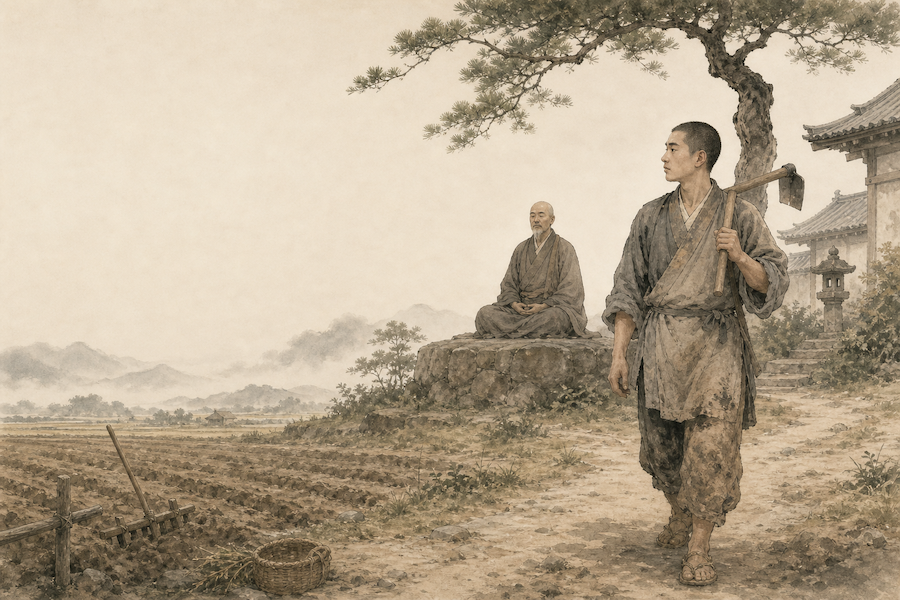
Rinzai, still young, has spent the day labouring in the monastery fields. He returns exhausted, clothes damp with sweat, while his teacher Obaku sits quietly, relaxed in meditation under a tree. Seeing him, Obaku says, “Hey, I see that you have been hard at it, you have been working hard, you are all sweaty and all that.” Rinzai’s response is simple and devastating: “Yes, but you should know the one who is not hard at it.”
In that single line, Rinzai names two simultaneous realities. On one side, there is the body and mind fully engaged in the activity of daily life: digging, carrying, sweating, responding to demands and deadlines. This is the domain of the personal, the “small mind” that navigates tasks, roles, and identities. On the other side, there is the “one who is not hard at it”: a transpersonal awareness that is not limited to the individual story, the effortless ground of experience that is never overworked, never hurried. Both are present at once.
You could picture this as a triangle. One side is our doing self: striving to be productive, spiritual, successful, enlightened within the personal frame. The opposite side is the transpersonal being: the quiet, ever-present capacity simply to notice, to be, to participate in something larger than the individual. At the apex, a meta or nondual level emerges that goes beyond the distinction between personal and transpersonal altogether. Rinzai stands right there: he is active as a person and at the same time already free in that nondual recognition.
Crucially, Rinzai does not need to leave the field, stop working, or renounce his duties in order to find this freedom. His teacher’s comment points to the visible, busy side of personal life. Rinzai’s reply points to the invisible, transpersonal side that Obaku, as a master, “should know” (and of course, his master Obaku knows that). Spiritual maturity here is not a lifestyle change but a shift in recognition: the “one who is not hard at it” is already present, whatever the outer circumstances.
For contemporary readers, this story gives a precise message: the question is not how busy you are, but whether you remember the part of you that is never busy. You can be in the middle of work, caregiving, research, or crisis, and still inhabit that apex where doing and effortless awareness, personal and transpersonal, are reconciled and then transcended. Activity continues; awareness can remain effortlessly open.

Rumi: Bitter soup, sweet water, and the futility of forced healing
Rumi captures the same insight in language that is sensuous rather than technical. In one well-known passage, he writes:
“Christ is the population of the world, and every object as well.
There is no room for hypocrisy.
Why use bitter soup for healing when sweet water is everywhere?”
The image is sharp. “Bitter soup for healing” is the way we often approach transformation: grim determination, self-improvement programmes, spiritual perfectionism, rigid moralism, and all the heavy recipes the personal ego invents to repair itself. We swallow one more bitter dose of discipline and believe that only through deprivation or self-attack will we become whole. This is a small mind desperately trying to fix the person.
Rumi’s question cuts through this: why insist on bitter soup when sweet water is already everywhere? In other words, why cling to hard, joyless strategies when the underlying reality is already permeated by presence, love, and clarity? If “Christ is the population of the world, and every object as well,” then the sacred is not scarce, hidden in elite practices or special places. It is saturating the environment, the body, the mundane objects around us. Hypocrisy, for Rumi, is pretending that the divine is distant and that we must exhaust ourselves to reach it.
In the terms of the triangle, bitter soup belongs to the personal: the cramped, personal self that believes it must fix, purify, and earn every drop of goodness. Sweet water belongs to the transpersonal field: the effortless sense of shared being and unconditional value that is already available, not as a reward but as a given. At the meta or nondual apex, the distinction between “me” and “Christ in the world” dissolves; one simply drinks, without owner or effort.
When Rumi says sweet water is “everywhere“, he is not asking us to work harder; he is inviting us to stop denying what is already flowing. The clear message for readers is that forced, joyless self-repair is not the path to healing. The more one tightens around bitter soup, the more one reinforces the belief that goodness is elsewhere. Genuine healing comes from recognising that “sweet water” means ease, kindness, and transpersonal presence already here, underneath the story that everything must be hard. The task is not to torture oneself into worthiness but to stop insisting that love cannot be this close.
Nisargadatta Maharaj: Effortlessness: nothing to do, just be
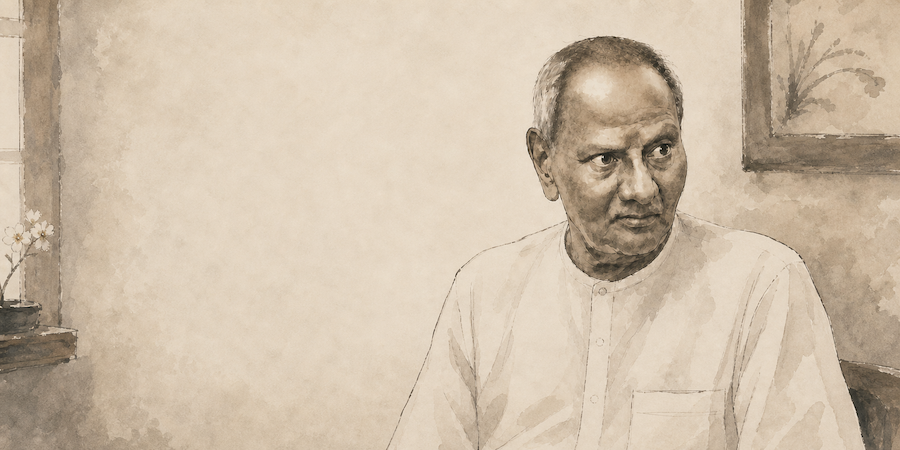
Sri Nisargadatta Maharaj is often associated with fierce nondual teachings, but the thread I want to highlight is very specific: effortlessness, and the fact that there is fundamentally nothing to practise, no long‑term project of self‑improvement to undertake.
He states the point with characteristic bluntness:
“There is nothing to do. Just be. Do nothing. Be.”
Elsewhere he insists:
“Abandon every attempt, effort, just be.”
The instruction is not a paradoxical technique. It is a direct refusal of the entire project of becoming at the level of small personal mind. For Nisargadatta, most spiritual effort is actually a way of postponing seeing what is already the case. We set up steps, disciplines, timelines, and inner negotiations: I will meditate more, heal my trauma, fix my personality, and then, perhaps, one day, I will be allowed to rest. His reply is uncompromising: “just be” now.
He drives the point further in his comments about “doership”. As long as we feel like the personal agent who is pushing life around, we remain bound to the personal narrative. The notion that “I” am the cause, the one making things happen, is precisely what keeps the mind contracted. Against this, he offers a radically simple view: there is only life, unfolding on its own. What you truly are belongs to a transpersonal and ultimately nondual dimension closer to the witnessing of it than to the pushing.
Perhaps the clearest sentence for your theme is:
“When effort is needed, effort will appear.
When effortlessness becomes essential, it will assert itself. You need not push life about.
Just flow with it and give yourself completely to the task of the present moment.”
Notice the precision. He does not deny that effort can arise in the personal field. Rather, he denies that you, as a separate controller, have to manufacture it through tension. When effort is genuinely needed, it appears of itself. When effortlessness is needed, it also appears of itself. The misunderstanding is the sense of personal burden, the feeling that everything depends on this separate “me” constantly trying.
So the message here is not an anti‑work slogan. It is that the deepest part of your being is effortlessness itself, at a transpersonal and nondual level. From there, effort can and will arise when appropriate, but without the self‑conscious strain of “doership”. You still research, write, care for others, and manage complex lives, but you do so from the recognition that life moves, and you participate, rather than forcing existence to obey your plans.
“There is nothing to practise. To know yourself, be yourself.
To be yourself, stop imagining yourself to be this or that. Just be.
Let your true nature emerge. Don’t disturb your mind with seeking.”
In practical terms, this means that rather than constructing another set of practices to reach some future state, one can begin by testing the hypothesis that “nothing to do, just be” is already available. Attention can relax out of the project‑mind and rest, even briefly, in simply being aware. Nisargadatta’s point is that this is not a mystical achievement. It is the natural meta condition, obscured only by the habit of effort.
“Hence awareness itself is all important, not the content of it.
Deepen and broaden your awareness of yourself and all the blessings will flow.
You need not seek anything, all will come to you most naturally and effortlessly.”

Lao Tzu: Busy people, quiet doing, and the way that does nothing
Lao Tzu’s voice in the Tao Te Ching adds an ancient Chinese articulation of the same discovery: that the deepest efficacy lies in non-forcing, and that busyness is often a sign of being out of alignment with the way.
One of the classic lines describing the action of the Tao is:
“The Tao does nothing, yet nothing is left undone.”
Here, “does nothing” is not laziness or refusal to act. It means that the Tao, the underlying way things are, does not push against itself. Water flows, grass grows, seasons turn, without the universe clenching around them. “Yet nothing is left undone” means that from this non-forcing, everything that needs to happen happens. At the transpersonal and meta level, reality functions without the personal controller.
This cuts straight across our cultural worship of busyness. A person can be constantly occupied, complexly scheduled and endlessly productive, and yet be working against the grain of the Tao: fighting, controlling, and subtly exhausting themselves. Lao Tzu’s teaching suggests that true effectiveness arises when one stops trying to dominate the flow and instead moves with it.
In many modern paraphrases, this is captured by his sharp observation: “It is better to be doing nothing than to be busy doing nothing”. Constant activity can conceal the fact that, at a deeper level, very little of real value is occurring. From a Taoist perspective, fruitless busyness is precisely busy doing nothing: burning energy without alignment, without contact with the way. Doing nothing in the Taoist sense, by contrast, means resting in non-forcing until an action that truly serves the situation becomes clear.
Another Tao Te Ching theme contrasts the sage with the busy fixer. The sage, seeing the world’s complexity, does not interfere, trusts the natural movement of things, and acts simply when needed. The busy person, believing that nothing will work without their constant intervention, overcorrects and ends up complicating what could have been simple.
The implied message for modern life is stark: being constantly busy is not evidence that you are doing things right. It may be evidence that you do not trust the way things move when you are not controlling them. The Tao Te Ching invites us to test the possibility that more can get done when we stop pushing and start listening. Action becomes lighter, more precise, less exhausting.
“It is better to be doing nothing than to be busy doing nothing.”
In the language of this triangle, Lao Tzu describes the apex where personal and transpersonal meet as wu wei: non-forcing, non-contrived action. You still respond, work, and sometimes make great efforts, but that effort is not backed by tension. It rides the Tao rather than fighting it, operating from a meta level where doing nothing paradoxically leaves nothing undone.
Drawing the threads together
Effort continues, effortless awareness remains
Across these four sources, the same core message emerges with different imagery:
-
Obaku and Rinzai show that you can be fully active at the personal level while already free, if you recognise the “one who is not hard at it” in the transpersonal and nondual.
-
Rumi asks why we cling to bitter, joyless strategies of small personal mind when sweet water, effortless transpersonal healing through presence and love, is already everywhere.
-
Nisargadatta insists that “there is nothing to do” and that effort will arise or subside on its own when you stop pushing life around and rest in the meta, nondual field.
-
Lao Tzu describes a way that does nothing yet leaves nothing undone, and warns that it is better to be doing nothing than to be busy doing nothing, inviting trust in non-forcing as the most efficient mode of action.
For a reader immersed in current cultures of productivity and self-optimisation, the radical proposal is this: keep acting, but drop the belief that the action must be accompanied by inner pressure. Let activity be a movement of life rather than a constant personal burden.
From a feng shui and environmental psychology perspective, this has practical implications. It suggests designing spaces, routines, and practices that support effortless awareness and transpersonal connection rather than endless self-correction: arrangements that feel already right enough that one can simply inhabit them, rather than environments that constantly tell us we are not yet good enough and must fix more things. At the meta or nondual level, the space and the person are not separate; there is just the way things are, moving without pressure.
According to the psychologist Abraham Maslow, one key trait shared by highly self-actualising individuals is that they dedicate a minimum of one hour each day to spending quality time alone in quiet reflection. This dedicated time for deep inner contemplation can be practised in various simple ways, such as meditating, praying, walking alone on a nature path or in the mountains, sitting peacefully by a stream or a fireplace, or even just listening to music. Taking this daily opportunity to be sincere and honest with oneself is considered a crucial, grounding practice for fulfilling our spiritual/transpersonal and personal potential.
In short, learn how to sit still, do nothing and be quiet. Ultimately, true spiritual action is not about forcing outcomes or asserting the ego’s will, but resting in a harmonious state where one realises that “All happens by itself” and “Neither the seeker, nor the Guru do anything”.